Thursday, August 20, 2015

the pretty old house with the long line outside

From the street. All cleaned up now.
Eventually a sign appeared announcing that the construction work that began clogging the narrow surrounding streets in 2013 had an interesting-sounding purpose--the grand building mostly hidden behind walls in Aix-en-Provence's Mazarin district was being transformed into an arts center.

It's been a year now since I officially lived in Aix, after calling this my home for nearly two years. But I've been nearby still--in a village outside of Aix and now in Marseille. Thus, I'm back in town fairly often. But this week I'm staycationing here (which is really just a short way of saying that I'm staying in my friends' apartment while they're away, watering their plants, working as normal, but trying to read a little more than usual). And it's been lovely to live here again instead of just passing through for a few hours here and there.
In the entrance hall, looking toward the
 front door.

Among my discoveries, some of them unpleasant (the bookstore on Place Richelme is a clothing store now? one of my Indian places has been transformed into something Italian or Spanish (I forget which)? and more...), has been the discovery that all that construction on Rue Joseph Cabassol has been replaced by long lines of people waiting to enter the new arts center. It's been unveiled!

And even better? I'm now 2 for 2 in testing out the policy many museums here have of letting journalists enter for free. I tried it for the first time in June at the Musée Regards de Provence in Marseille and have decided it's a very smart policy.

So, courtesy of that policy, come along with me on today's wanderings through the Caumont Centre d'Art, which was restored and is run by a group called Culturespaces. The center opened in May of this year in a former private mansion that was built in the 1700s. I feel a little like it's more "mine" than most museums since I saw it (from the outside, anyway) before it was made beautiful again. Knowing how new it is is a marker showing that I've lived some life in this corner of the world now. I've been here long enough to know which cultural venues are new and which ones predate 2012. That's something.

A fancy 18th-century bedroom, with a nice digital tour guide.
Anyway, back to the Caumont Centre. For starters, I'll just say that everything seems to be done really well. From their website, which is full of interesting info (and was clearly translated into/written in English by a real person who is not named Google Translate), to the exhibit, it was just all nicely done. The building is gorgeous, and the tour includes a couple rooms restored to typical finery for the wealthy nobles of the 18th century. There are also lovely gardens and a cafe.

Beyond all that, the Hôtel de Caumont will host major temporary art exhibitions. This first exhibit inside the lovely mansion is comprised of the paintings of Canaletto (Giovanni Antonio Canal), an 18th-century Venetian painter. Check out this link to enjoy a virtual version of the exhibit and learn a little about Canaletto's impressive oeuvre.

But Canaletto's isn't the only art on feature. Until November 1, the main courtyard features the ethereal photographic work of contemporary (he's barely older than me) French artist Laurent Chéhère. The works are derived from his series "Flying Houses." To celebrate Caumont Centre's grand opening, Culturespaces commissioned Chéhère "to design an illustration announcing the venue's opening following its complete restoration," per a press release.

At the end of the exhibition, signs directed guests to descend from the third floor via back stairs, where at each landing, there was a collection of photographs from the restoration of the building. It was a great way to wrap up the tour, and I'm so glad they chronicled the process of bringing the house back to its former glory. You can see those photos and more details of the restoration process here on the centre's website.


Wednesday, August 19, 2015

when that bill bryson guy traveled in europe...

Book One
In the fake war that has emerged between these two accidental combatants, courtesy of being read one after the other, Book One (aka: The Beautiful and the Damned by F. Scott Fitzgerald), as pictured at left, versus Book Two (aka: Neither Here Nor There: Travels in Europe by Bill Bryson), see photo below, Book One wins hands down in the design category. It has the kind of cover that's frame-able and full of all kinds of writerly inspiration. Book Two was definitely not selected based on the merits of its very, very uninspiring yellow jersey.

But...

I've recently finished reading Book One, mostly out of sheer determination and maybe partly to honor its gorgeous cover. Take all the depressing parts of The Great Gatsby and make them much longer, and that's this book. But I suspect there's something redeeming to be found, I just wish I had a book group to help me find it. And to be sure, there were a few passages that I noted with my reading pencil for their turns of phrase or literary merit. But mostly, I was so very glad to finish the book and move on to Book Two.

I'd never heard of Bill Bryson before my 2007 four-month escapade to Africa, but once there, I began to find his books prominently featured in bookstores across the continent, or at least the ones I went to in Kampala, Uganda and Cape Town, South Africa. Who was this ubiquitous guy? Once upon a time sometime after Africa, I finally read I'm a Stranger Here Myself, but, well, I didn't love it. What I read there did not merit this
Book Two
international notoriety I'd witnessed. But then I heard that that book was not his finest shining moment, so I gave him another try and picked up this ugly used edition from his vast oeuvre at the English bookshop in Aix-en-Provence. Determining the quality of the work within Book Two would clearly not in any way be affected by any assist from its cover.

So, anyway, that's the tome I'm reading now and enjoying more than poor Book One. And since I don't have a book group to discuss these things with, here are a couple of my fave quotes so far...

Chapter 3 - Oslo

"One of the small marvels of my first trip to Europe was the discovery that the world could be so full of variety, that there were so many different ways of doing essentially identical things, like eating and drinking and buying cinema tickets. It fascinated me that Europeans could at once be so alike--that they could be so universally bookish and cerebral, and drive small cars, and live in little houses in ancient towns, and love soccer, and be relatively unmaterialistic and law-abiding, and have chilly hotel rooms and cozy and inviting places to eat and drink--and yet be so endlessly, unpredictably different from one another as well. I loved the idea that you could never be sure of anything in Europe."

This is just really nicely said. Especially apropos while living in Provence is that part about living in little houses in ancient towns. There are so many ancient towns here that, well, after three years here I kind of understand how people eventually just have to get on with their lives. You can't necessarily drink in the wonder of your ancient town every single day.  At some point you have to stop wondering and wash your dishes already.

"When I told friends in London that I was going to travel around Europe and write a book about it, they said, 'Oh, you must speak a lot of languages.' 'Why, no,' I would reply with a certain pride, 'only English,' and they would look at me as if I were crazy. But that's the glory of foreign travel, as far as I am concerned. I don't want to know what people are talking about. I can't think of anything that excites a greater sense of childlike wonder than to be in a country where you are ignorant of almost everything. Suddenly you are five years old again. You can't read anything, you have only the most rudimentary sense of how things work, you can't even reliably cross a street without endangering your life. Your whole existence becomes a series of interesting guesses."

Personally, I think what I enjoy more than the not-knowing is the feeling of accomplishment when you break the code and manage to understand anything at all because you've put all the clues together and deduced some aspect of heretofor unknown humanity.

Chapter 4 - Paris

"...at least [the hotel] didn't have those curious timer switches that used to be a feature of hotel hallways in France. These were a revelation to me when I first arrived from America. All the light switches in the hallways were timed to switch off after ten or fifteen seconds, presumably as an economy measure. This wasn't so bad if your room was next to the elevator, but if it was very far down the hall, and hotel hallways in Paris tend to wander around like an old man with Alzheimer's, you would generally proceed the last furlong in total blackness, feeling your way along the walls with flattened palms, and in invariably colliding scrotally with the corner of a nineteenth-century oak table put there, evidently, for that purpose."

Maybe the hotels have done away with these, but apartment buildings here sure haven't. You haven't lived in France until you've been trapped going up or down stairs when the light times out. Sometimes the switches have glowing lights to announce where they are on the wall, but not always. It's even better when you're moving in or out of an apartment or just plain carrying anything of substantive size (which is common since, you know, there's often no elevator, so anything that enters your house has to be carried up stairs). Stairs become very treacherous in the dark. It's the kind of thing horror stories are made of, and you don't even need to pay a scary bad guy to show up. This kind of horror is very, very cheap.

Thursday, August 13, 2015

pulling back the curtain on village life

One need not go far to find one of the picturesque villages that sun themselves atop so many of Provence’s hills. Views of their clumped-together, ancient, warm-colored stone homes and the church bell tower that usually rises from their midst make it easy to imagine the idyllic life that’s lived along these villages’ quaint and very old streets.

For the past two-weeks, I’ve been house-sitting for friends who live just below one of these gorgeous gathering places. I’ve walked through Ventabren village a couple times before this but never alone and never with real time for wandering.

But I’ve now done both. And it’s been one of the treats of this house-sit to climb the stone-cobbled chemin up to the city during a couple recent twilights and listen to sounds of dinnerware clinking and pleasant conversation as I wind my way through the close-set homes. I found myself wondering--and even assuming that it must clearly be so--whether life on this hilltop is as convivial as seems possible. Surely, everyone knows their neighbors—the several hundred others perched there together—and it’s one big happy French family. Right?

Well, sometimes assumptions don’t hold up.

Today I managed to rouse my night-owl self early enough to attend the village church’s 9 a.m. Wednesday morning Mass. It’s August, which is high vacation season here in France and a time when many things shut down, so I wasn’t 100 percent certain the doors would really be open. On Sundays the services rotate between this church in Ventabren and those in a couple other nearby villages.

But the doors didn’t disappoint, and I slipped onto a bench a few rows behind the three other women who composed the morning’s congregation.

When it was time to “pass the peace,” it was nice to see real warmth in their eyes as they greeted me, the interloper in their village community.

My other goal for the morning was to visit the village bar/café, but it wasn’t open yet, so I climbed up to the very top of the hill to enjoy some reverie and prayer with a cicada choir for accompaniment while I regarded the quiet, green valley below.

Then as I descended, I exchanged bonjours with an older man who was also descending into the village. We enjoyed a friendly chat as we walked down the stone stairs past the ruins of the 12th-century chateau of Queen Jeanne that put Ventabren officially on the map back in the day. The man was born and raised in Ventabren, though not in the village itself, and has always
lived in this corner of the world. Despite never moving away, renewing his passport is one of the tasks on his to-do list, since it expires soon. As we passed the former school turned present-day library, he noted that this is where he spent his elementary school days and pointed out the spot where a wall used to separate the back courtyard—pre-dating his school-time era—to provide one courtyard for girls and one for boys. There was a day when the genders didn’t mix at school here.

We parted ways, and I arrived at the tiny café. Its four round tables stretch across the small front terrace. Inside there’s a typical wood-paneled bar and some walls of shelves filled with beer. I learned that the area marked “private” to the right of the bar wasn’t seating for private functions as I first assumed. It’s the proprietor’s kitchen.

Throughout a pleasant hour and a half, I was busy. I gazed at things. I read. I took obligatory Instagram photos. I exchanged bits of pleasant conversation with other customers. It was all quite friendly. Just like village life should be. Right?

But the most interesting part of the day came while I chatted with the owner and finally got to ask all of my burning village-life questions.

And here’s what I learned. Sometimes assumptions don’t hold up.

Mr. Proprietor has lived in Ventabren for 30 years. Before that, he was from nearby Aix-en-Provence, for the first 25 years of his life. In addition to running his café/bar, he does some odd jobs for the town hall, which include providing transportation for elderly folks to a weekly meal at the school (during the school year) and delivering official documents to offices in Aix.

His café is only open during the summer – in part because there’s no space inside for tables and the terrace isn’t so pleasant in the cold, but also because most of his visitors, like all the other customers I talked with, are tourists, not locals. So he’s open during tourist season.

His café and one restaurant are the only businesses in the village. These survive, he says, partly
because they aren’t dependent on the locals to keep them going. But the village bakery, a staple of any French community, shut down 20 years ago.

And here Mr. Proprietor explained that there are three things needed to support a thriving local business culture in a village...and to support all those idyllic images of relaxed, sun-baked community life:
  • The village needs at least 1000 inhabitants. Ventabren village (the commune includes more than just the village, so “Ventabren” officially has a larger population than just the village’s numbers) only has 400-500.
  • The village needs a central plaza where the community can regularly gather. Ventabren doesn’t really have this. Apparently, twice a year village residents enjoy a potluck together, but that’s the real extent of the neighborliness. So much for all those idyllic images. Half the village is composed of renters who rotate regularly, so this affects village life. He said people are neighbors but not really friends.
  • The village needs not to be too close to other larger towns and cities with all their amenities. Ventabren, for example, is a 20-minute drive from Aix and 30-45 minutes from Marseille, with the region’s largest commercial districts lying between Ventabren and Marseille.

Thus, as a result of all these things, Ventabren is something of a really pretty dormitory. People go out during the day to their jobs and other activities and come back at night to sleep in their very old stone homes. And that’s as good as village life gets sometimes. If you want the quiet and want to keep to yourself, then maybe this still sounds like idyllic village life to you. For others of us with busy imaginations and dreams of community hugfests (or bises-fests, as it would be here), it might be good to remember that Ventabren—and other Provençal villages like it—looks good on Instagram but might not be your best French dream after all.

My conversation with Mr. Proprietor was interrupted by the arrival of a French girl from Aix with her French guests, an older couple from Paris. Eventually they started posing many of the same questions as I did about village life. It’s not only we Americans who are curious about the daily goings-on in the villages of Provence.

Tuesday, July 21, 2015

along a country road with a bunch of people on bikes


Earlier today some friends and I set up camp along a random stretch of country tarmac well north of where we normally pass our French days. Upon blankets and camp chairs claiming the scant few feet between the edge of the road and the ditch-like descent into brush, we picnicked, while other small smatterings of families and friends did the same thing along the same road. The occasional official-looking car passed by. Some drivers honked. Some passengers waved.

But then: Sights. Sound. And action!  The caravan was arriving! With music, trapeze-swinging animators, cars that no longer look like cars because they're wearing sunglasses, and...FREE STUFF! It's a parade on steroids--since the second part of the day's attraction doesn't allow steroids, the parade put on by the Tour's sponsors gets them all.


I missed this part of the merriment two years ago when the Tour de France passed through Aix-en-Provence. I must confess that since there are a lot of things in the world to pay attention to, the Tour de France hasn't managed to make the short list in my life. But when its route around Aix passed along the periphery road, a two-minute walk from my little studio apartment, I figured I needed to see it. Plus, the circus performer types who had jumped and rolled and stilted through town a couple days before to drum up excitement had given me a Tour de France key chain. Out of gratitude I had to go. But no one told me to go early enough for the parade. So I didn't know what I'd missed until today.


The 2013 Tour de France advance team in Aix-en-Provence.
But as cool as it is to fish free stuff out of the weeds, the best part is still the bikes and their masters. Two years ago, Aix was the beginning point for one of the stages, so when the bikes passed by, everyone was still clumped together and following city speed limits or something. However, for our countryside cheering near Veynes, the peloton had split into two groups. This is a good thing because I'd decided just to take video and not try for photos so I could concentrate on what I was seeing. However, I forgot to flip the camera off of selfie mode after that selfie we took in our free hats from the caravan, so all I got of the lead riders was video of myself yelling for them. Lovely.

But fortunately there was time to regroup before the rest of the riders whooshed past in all their colorful glory.


There’s something so surprisingly beautiful about it all. And it goes by so quickly. All your senses are adjusting, trying to figure out how to take it in, trying to figure out where to focus, and just as you’re almost acclimating to what’s going on, it’s over. And there’s no redo. No replay. No, “let me see that again and focus on some other part of it, please.” And sometimes, somehow, that’s got to be enough--a few seconds of beauty to be thankful for.

The countryside of which I speak. (2015)
And for your future reference, our little group voted unanimously (I think, anyway) that given the choice of walking out our front door to watch the Tour pass through town or driving two hours to see it in the countryside, the countryside wins.

Our band of fans on the roadside. (2015)

The riders arrive! in the 2013 stage
 that passed through Aix.
2013 in Aix.

2013 in Aix.

Thursday, June 25, 2015

my balkans story in the washington post!

I've been published in the Washington Post! Exciting, right? 
Somewhere in Montenegro. July 2014.

Um, well, kinda. 

One of the big reasons to seek getting articles placed in these big outlets is that the stories will reach more people. Except that in the wonderful real world of publishing and editing, sometimes the story gets lost. 

Per the editors' requests, I wrote a long account of mine and Olivier's 12-day road trip in the Balkans. Difficult to condense down to however many words I was given, but I tried.

In the end, after the usual edits, they decided to run the story more as a photo essay than an article. Okay, no problem. Photos make for a cool spread, and it's great that my friend Olivier has ended up being an equal partner in what's been published.

But the way the story is cut, well, it leaves readers hanging. It's like the story's just getting started and then it ends. Friends who've read it have asked where the rest of the story is.

Anyway, that's how freelancing works. Once I sell them the story, it belongs to both of us, not just to me anymore.

So with those caveats, here's the link: "Driving through the Balkans, a rocky road"

Enjoy! And stay tuned. There's more to the story, and hopefully one day I'll find a place to tell it.

Monday, May 11, 2015

la vie est belle


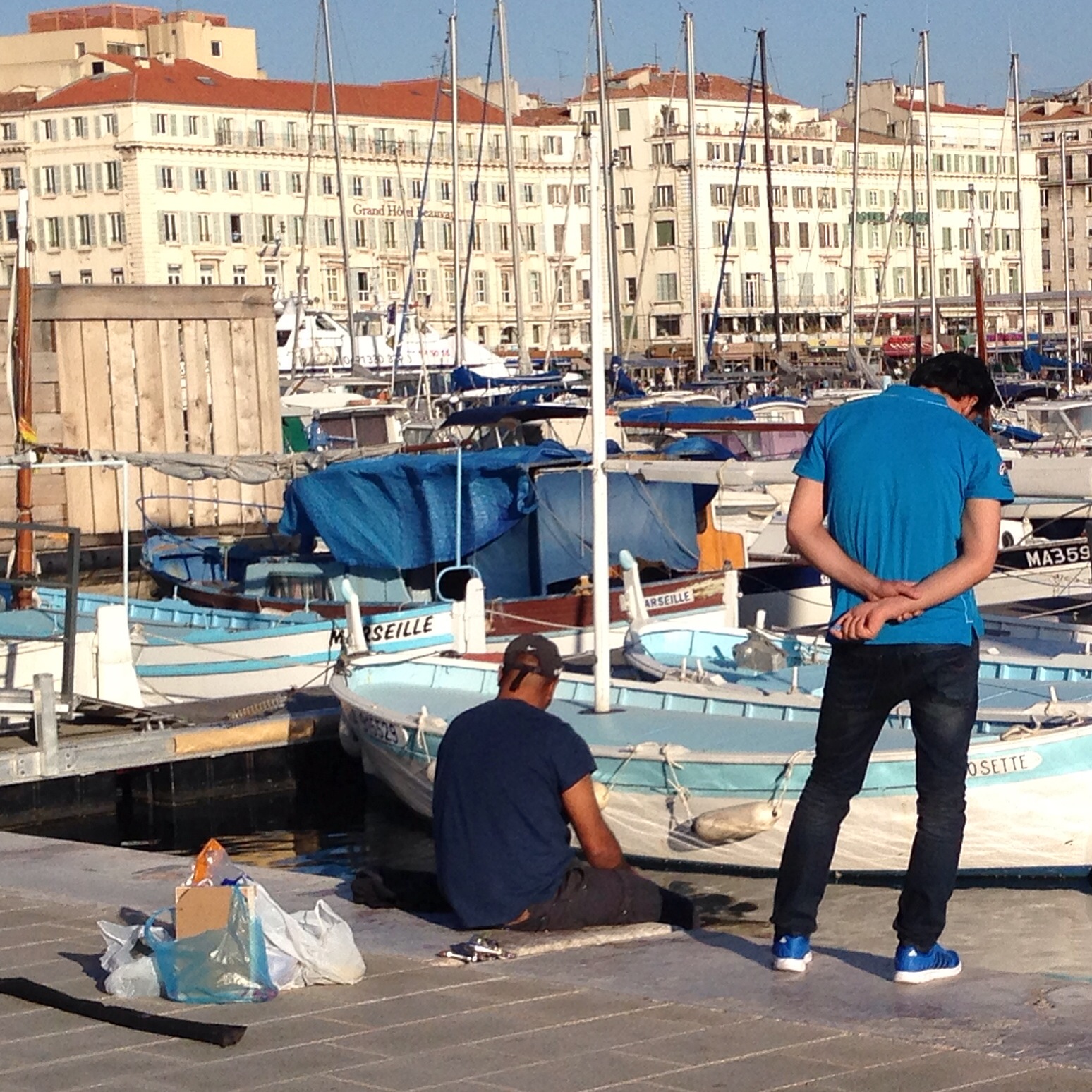
The Vieux Port is getting busier these days. A couple days ago a huge yacht was tied up there, dwarfing all the smaller boats who thought they were cool until the new three-masted kid showed them up. I was curious and asked one of the employees guarding the gangplank what all the pomp was. He told me it was a cruise. So I looked it up a minute later when I was back home. He was right (imagine that! Maybe it’s more accurate to say that the surprising thing is that I understood him correctly!). Check out Le Ponant for your next yacht-cruise. You know, if you don’t own your own yacht, that is.

It’s a new thing to be confident enough in my French to ask extraneous questions. This may be more exciting than seeing strange boats in the neighborhood.

Yesterday I finally noted that more of the smaller vessels that are docked in the Vieux Port are heading out to sea. I guess the weather—it was AMAZING this weekend—is finally good enough for pleasure boating. I’m new to this whole living-by-the-sea thing, so my mountain-born self thought people would be hitting the high seas the minute the winter rains ceased.

Life is beautiful.

~*~

I’m enamored with the Vieux Port. It’s only been around since 600 BC when Phocaeans from Phocaea (modern-day Foça in Turkey -- not to be confused with the Phoenicians from Phoenicia in modern Lebanon, Israel, and Syria) saw its value and opened a trading post nearby. Vieux—“old”—is practically an understatement. Today it’s the biggest gold mine for people-watching. Especially in the evenings, it’s just full of a fascinating variety of people. Lots of families, with parents from all over the world all warning their children away from the water’s edge. Apparently, children of every nationality have to be taught that bad things happen when you run full speed ahead off the edge of something that borders water. Once everyone is safe, parents can be spotted helping their small kids spot the fish swimming below the fuel-stained water. 

Tourists and picture-takers abound. And people lounging on benches. Young and mid-aged men of Arabic descent. Cute, withered old couples. Joggers of both genders. Men, sometimes with a child in tow, fishing. One day there was what appeared to be a mom and three teenage daughters kicking a soccer ball around in a circle—dressed in normal casual attire, not anything particularly sporty. Usually there are two or more groups of musicians enamoring the crowd and earning tips. There’s the guy that sells the chocolate covered almonds (or some other nut, I haven’t verified which one) from his little white cart with stickers on the sides. They smell scrumptious. Maybe one day I’ll drop a euro there.

Life is beautiful.

~*~

Seagulls regularly soar past my fourth-floor windows (as if on cue, one just swooped past as I started typing this sentence). Yesterday around 7:30 pm the light coming from the west and shining on the building across the street was gloriously golden. And instead of seeing the seagulls themselves, I watched their shadows swoop along the building opposite. It was a show I wanted to watch for a long time.

But I had to return to my work.

Like I do now.

Life is beautiful.


Wednesday, April 22, 2015

lunch in montenegro

To make up for my dearth of promised reporting on last summer’s oh-so-lovely Balkans road trip, voilà, a little account of A Lunch in Montenegro.


During the two-day return trek north from Albania back to France, Olivier and I ended up stopping for lunch on Return Trip Day One at a resort on the Montenegrin islet Sveti Stefan.

Being the go-with-the-flow travelers we are, we didn’t make any advance plans for pit-stops. Once we began to be hungry, we started consulting road signs and maps for a place to munch.

We found a pretty looking place—well, let’s just be honest: it was gorgeous—for lunch that day, so we pulled into the parking lot and began looking for the restaurant.

The beach, the buildings, the setting all seemed really well-to-do, but we’d been eating cheap for most of the trip, so it was nice to decide to have a little lunch splurge. It wasn’t until after that fact when I recounted the details to my friend Cydil, our host in Albania, that I learned just how exclusive this lunch stop was. She didn’t know it was possible to get onto the resort’s islet without an advance reservation and thought that overnight stays ran a minimum of 1500 euro/night. Fortunately, lunch was not quite as expensive as that.

When we asked at a covered booth at the edge of the beach and beside the bridge to the island, the hosts said we could call about reservations for the next day. We explained we wanted lunch that day. Tout de suite. Then they acknowledged there were tables available still that day and without further ado escorted us over a narrow isthmus through a 15th century village turned resort to an umbrella-covered table overlooking the sunny Mediterranean waters.

We decided we could probably manage to handle the ambiance. It was our most expensive meal of the trip, but the pasta and salad and dessert were delicious. And the view was worth whatever extra we paid to eat there.

However, I don’t think an overnight stay at Sveti Stefan is ever in our future. Lunch will have to suffice.


Sunday, March 29, 2015

balkans outtakes you don't want to miss

Ljubljana. July 2014.
It’s been three-fourths of a year since that road trip through the Balkans last summer that I promised to write about more here. I must apologize for the whole not-keeping-my-promises thing. I suppose you’re hugely disappointed and have had to seek counseling to overcome your rage. So sorry. ;-)

Anyway, I’m presently revisiting the trip for a travel story pitch that, in the way of publishing’s slow-turning wheels, has finally been picked up, which means I’m plumbing my memory, my journal, and my notes for all the details I can get my fingertips on from that trip.

Here are a few overview thoughts that won’t make it into the article. These are the outtakes, I suppose. But brilliant outtakes they are, so read with attention, please. ;-)

To recap: I went on a little 12-day road trip with my friend Olivier to visit some other friends. We started out in Aix-en-Provence, France, drove across Italy, and slept our first night in the Balkans in Ljubljana, Slovenia (though apparently some scholars don’t agree over whether Slovenia is officially Balkan…if I’d known this ahead of time, I would have polled the Slovenians I met ;-) ). From there we traveled south, eventually traversing Croatia, Bosnia-Herzegovina, Montenegro, and northern Albania, before driving through all those countries again on the return trip.

Similarities
Of course, one road trip does not Balkans experts make us, but the choice to descend the peninsula by road gave us a chance to observe a little the ways these countries aren’t all the same as well as how they do fit together with some regional commonalities.

For starters, a somehow-comfortable melancholy seemed to pervade the landscape all along our route. Melancholy can be soft or harsh, and this version seemed to veer toward soft, honest.  

A lingual current also ran south with us. Though the languages are different, key words for tourists were similar—the restaurans, the stari mosts, and more.

To Each His Own
But each country also seemed to have its own personality—one it would have been nice to mine more deeply:

Slovenia seemed lively yet calm, two adjectives that admittedly don’t seem to go together, yet they meet in Ljubljana, Slovenia’s capital. This country has seen less war than Croatia and Bosnia, and one can sense this.

Croatia is absolutely beautiful yet feels already discovered. It didn’t feel so off-the-beaten path as the other places we visited. Like Slovenia, it’s already a member of the EU, though it’s not yet in the eurozone while Slovenia is. And tourism is already a big deal in Croatia, which has a good reputation for knowing how to showcase its part of the region’s treasure collection. Overdone tourism can make a place seem stripped of personality. But we also didn’t have any local guides in Croatia, so it’s possible we just missed the good parts.

Bosnia felt potentially dangerous, courtesy of its recent past, without actually being dangerous at all. Thus, it felt like a place not-yet-fully discovered. Tourism hasn’t been overdone here yet (YET!), while at the same time, there are growing resources for tourists.

Montenegro was just green and beautiful. We didn’t stop off in any large cities, so our route through Montenegro’s mountains gave the impression of a country of tucked-away hamlets that keep to themselves but are welcoming when you enter them.

And Albania felt like a place wrestling more than all the others with its past and its present. It’s in that awkward adolescent stage. Where Bosnia appears to have chosen a direction, Albania is still working to fully aim itself, but this is part of its charm for those travelers who enjoy discovery and a little dirt mixed in with glitz, antiquated farm implements and the occasional donkey mixed in with modern multi-story homes and lots of new-looking cars. Tirana, Albania’s capital, is a happening place, with plenty of nightlife, a place definitely in transition.


For the super-motivated and curious, here’s a link to a very helpful overview of the region’s complicated (for us outsiders anyway) recent history: “Understanding Yugoslavia.”

Friday, December 5, 2014

second floor perspective

For the past three weeks, I've been living in temporary housing back in my old neighborhood here in the center of Aix. It's nice to be back after spending the summer and first part of fall in Bouc-Bel-Air, a village outside Aix.

During my nearly two years living in centre ville, I was in a ground floor studio apartment. It had its charms, but the views were not among them, though I suppose you could call it exciting to get to watch the Germans try to back their car into the garage across the alley from my windows. And sometimes I could see a sliver of sky that lit up nicely in the morning. But mostly, I could see the wall across the street. Not exactly the stuff of inspiring vistas.

My temporary abode, though, is the epitome of inspiration. With four grand windows looking down onto street level shops and across to apartments and tiled roofs and over to the tiny place (plaza) with the empty press kiosk, the small fountain, and the grand trees, all with people passing to and fro, well, I could be mesmerized all day long. My very own reality TV show passing below my windows. Alas, life's been too busy in these three short weeks to spend much time watching TV.

In addition, it's lovely to gain a different perspective on Aix by viewing it from aloft. The streets, the windows, the roofs all look so different from this perspective. I think there's a metaphor in there somewhere, but I'll let you find it yourself.

To whet your appetite to the reality-show-that-won't-be-realized, voilà - some stills from "Slice of AixLife: Rue Jacques de la Roque."

First, the place and the businesses:


Next, some neighbors, or at least their homes:


Like me, the girl who lives behind the two windows on the bottom
left keeps the shades open a lot. I think she's a student, and she
has a big cat. I like knowing about my neighbors - but is that
stalking or just being neighborly?

The Chair-Fixer guy: I've seen him there before because this is my 'hood, after all, but I never realized he was there SO often. Almost every day. And not only does he advertise at this corner, but he also actually fixes chairs here, wetting the straw straps in the plaza's fountain.


Transport: This street connects with the busy periphery road and has a reasonable amount of its own traffic for such a narrow street.


Finally, some neighborhood night shots:


It's not the best shot, but that bright light
dot is a star I can see from my
temporary bed. It's lovely.